
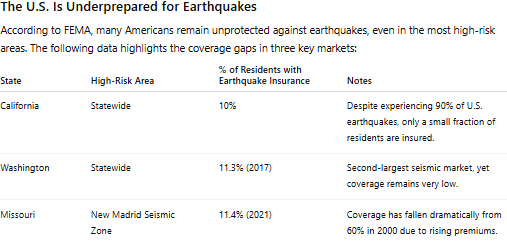
According to FEMA, many Americans remain unprotected against earthquakes, even in the most high-risk areas. The following data highlights the coverage gaps in three key markets: (Refer to the image)
A Guide Through Earthquake Policies
March 25, 2026
What Is an Earthquake Policy?
An earthquake insurance policy is a specialized form of property insurance that protects your home and belongings if they’re damaged by an earthquake. Unlike standard homeowners or renters insurance, which generally does not include earthquake or earth movement damage, this coverage must be added as a separate policy or endorsement to your existing plan.
Typical earthquake coverage may include:
Typical earthquake coverage may include:
- Structural damage to your home
- Repairs to personal property (inside your home)
- Debris removal
- Additional living expenses if your home is uninhabitable
(But be sure to read your own policy — coverages and exclusions vary between insurers.)
Why You Need It When You Are in Washington State
Washington State sits in one of the most seismically active regions of the U.S. Its earthquake risk is driven by major faults like the Cascadia Subduction Zone, Puget Sound faults, and other shallow crustal systems — all capable of significant seismic events.
Yet, standard home insurance policies almost always exclude earthquake damage, meaning if your home suffers earthquake damage, you’d be responsible for the full cost of repairs without quake coverage.
Given this reality, earthquake insurance becomes a critical layer of protection for homeowners and renters who want to maintain financial security and peace of mind in the event of a major quake.
Statistics: Who Has — and Who Doesn’t Have — Earthquake Coverage
Across the U.S., only about 11% of homeowners have earthquake insurance, even though many more are at risk.
In Washington State specifically, estimates suggest roughly 12–15% of residents carry earthquake coverage — meaning the vast majority (85–88%) do not.
For comparison:
- In California — another high‑risk state — earthquake coverage is owned by only about 10% of residents.
- In Oregon, around 20% of residents carry quake insurance.
These low adoption rates are often due to misconceptions about coverage, cost concerns, and the mistaken belief that government disaster aid will cover losses.
Benefits and Coverages of an Earthquake Policy
~Core Benefits~
Dwelling Coverage
Helps pay to repair or rebuild your home’s structure after quake damage.
Personal Property Coverage
Reimburses loss or damage to belongings inside your home.
Additional Living Expenses (ALE)
Covers temporary housing and food if you must move out while repairs are made.
Debris Removal
Helps with cleanup costs after a damaging quake.
Optional or Add‑On Coverages
- Other structures (e.g., detached garage, sheds)
- Building code upgrades (costs to meet new construction codes)
- Land stabilization (where available)
Why It’s Important to Work With an Insurance Broker?
Earthquake Insurance Is Not “One Size Fits All”
Earthquake policies vary widely in terms of:
- Deductibles (often percentage‑based, like 10–25% of the coverage limit)
- What’s included and excluded
- Premium costs based on location, soil type, and structure type
A
licensed insurance broker can help you:
✅ Compare multiple carriers and quotes
✅ Understand what specific events and costs are covered
✅ Evaluate the right deductible for your budget
✅ Spot coverage gaps that could leave you exposed
Because earthquake policies are complex and vary by insurer and region, a broker’s expertise can make a significant difference in finding the best protection for your assets.
~Final Thoughts~
Living in Washington State means you’re in a region with real earthquake risk, yet most residents don’t carry earthquake insurance. That gap can leave homeowners and renters financially exposed when the next seismic event strikes.
Here’s what to remember:
- Earthquake coverage is not included in standard home insurance.
- Only a small fraction of households have quake protection, even in high‑risk states.
- Earthquake insurance can cover structural damage, belongings, temporary living expenses, and more, but you need to read your policy carefully.
- Working with a knowledgeable broker improves your chances of securing the right policy for your situation.
In a state like Washington, earthquake insurance isn’t just another policy — it’s a financial safeguard that can protect your home, your belongings, and your future.

You might also like
Haley Insurance Agency Blog

What Is Life Insurance? Life insurance is essentially a promise between you and an insurance company. In exchange for regular payments—called premiums—the insurer agrees to provide a lump sum, known as a death benefit, to your loved ones if something happens to you while the policy is active. Think of it as a financial safety net for the people who depend on you. Many people say, “I have life insurance through my job, so I’m covered.” That’s true… for now. But here’s the catch: employer-provided life insurance usually stays with the company. If you change jobs—which, on average, Americans do every two years—you may need to go through a new application process to keep coverage. That’s why having your own independent life insurance policy can be so important—it ensures your protection follows you, not your employer.

For most people, buying a home is the biggest financial decision they will ever make. It’s where families grow, memories are made, and life happens. But while homeowners spend years paying for their homes, many still aren’t fully sure what their homeowner’s insurance actually does. Understanding how a homeowners policy works can help you protect not only your house, but also your finances and peace of mind. Let’s break it down in simple terms.
If you’re a homeowner, you may have noticed your insurance premium increase over the past few years. Many families across the state are asking the same question: Why is my insurance getting more expensive? The answer isn’t just one thing. Several trends across the country — including rising building costs, more homes in risk-prone areas, and stronger weather events — are influencing insurance prices. Understanding these changes can help Washington homeowners make smarter decisions about protecting their homes and finances. This article is based on publicly available research and industry insights reported by Verisk Analytics, a company that studies risk patterns and insurance trends across the United States.